the center for information alternatives gallery
new york city
cia gallery homepage
JARID BLUE ARTIST INTERVIEW
SOLO EXHIBITION: JANUARY 18TH, 2026
blog posted 12.22.25
CIA GALLERY:
Tell us the basics of how your Light Baths works, and how it is unique from other projected light projects.
JARID BLUE:
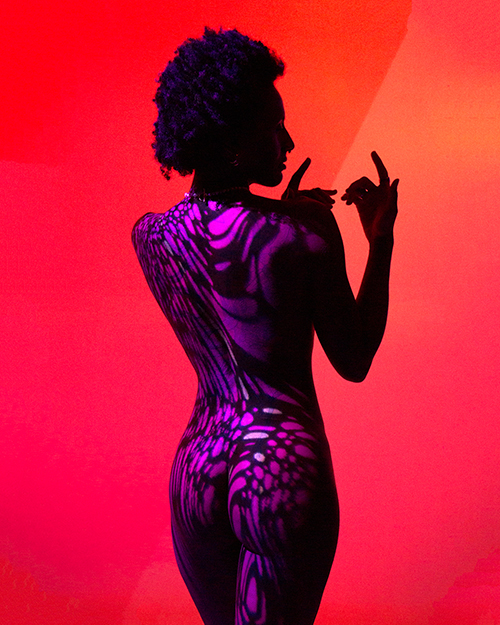
Light Baths is a long-running project in which I use projected light, texture, and pattern to transform bodies, objects, and spaces. While the work is often experienced visually through photographs or installations, the core of the project is deeply personal. The primary intention is not spectacle for an audience, but the individual experience of becoming the artwork.
Participants step into projected environments where their bodies become the surface for light, color, and form. In that moment, they are not posing for an image so much as inhabiting one. The photographs and videos that emerge are artifacts of that encounter, evidence that the experience took place rather than the work itself. What makes Light Baths distinct is this emphasis on embodiment, self-recognition, and transformation from the inside out.
CIA GALLERY:
What are the more interactive, ephemeral, and immersive elements of your work, versus the more collectible and object-based, and how do they interweave?
JARID BLUE:
The interactive and ephemeral elements live in the act of participation itself. Each Light Bath is temporary, intuitive, and responsive to the person in front of me. The experience exists once, in real time, and cannot be fully replicated.
The photographs and prints function as physical artifacts of that moment. They hold emotional residue rather than documentation alone. These objects allow the experience to travel outward into homes, collections, and galleries while still carrying the intimacy of the original encounter. The work moves fluidly between experience and object, with neither existing fully without the other.
CIA GALLERY:
You have had a number of solo shows with local galleries, Satellite Art Show, and Chashama in the past five years. What has changed about your process as you took your in-studio techniques out into a wide variety of arts spaces?
JARID BLUE:
Working across different spaces has made my process more flexible and less precious. Light Baths began in small living rooms, kitchens, and improvised studios, so adaptability has always been part of the work. Bringing these techniques into larger galleries and public-facing environments has allowed me to think more expansively while still honoring that improvisational core.
I’ve learned to let the space lead more, rather than imposing a fixed outcome. Each environment asks for a different rhythm, scale, and level of intimacy. That shift has made the work stronger, more responsive, and more open to experimentation.
CIA GALLERY:
Which projects have you recently released or hope to work on in 2026?
JARID BLUE:
While the core of Light Baths remains focused on intimate, individual encounters, my recent work has leaned more intentionally into collaboration. I’ve been working with a production group on a recurring performance series at Cipriani, bringing my projection language into live stage environments. I also collaborated with the art duo Mookntaka on Governors Island, projecting moving patterns onto one of their large inflatable sculptures and inviting new forms of movement and interaction within the piece.
Looking toward 2026, I’m interested in expanding the project in a few key ways. I want to continue developing portrait work that introduces color as negative space rather than relying solely on darkness. I’m also drawn to bringing projection into natural environments, building on recent work created outdoors. Most importantly, I’m exploring more public-facing, self-guided installations that invite participation without requiring a formal portrait session, creating accessible, community-centered experiences where people can encounter themselves through light.
CIA GALLERY:
How should artists innovate in the current shifting landscape? What are different ways of broadcasting your work and carving out opportunities which you would recommend to others in the creative fields?
JARID BLUE:
I think innovation starts with showing up. Being present in the communities you care about, contributing consistently, and building trust over time matters more than chasing visibility for its own sake.
Beyond that, artists have to ask honest questions of themselves. Does this work feel necessary to make? Does it feel generative and fulfilling? And does it add something meaningful to the conversation it’s entering? When the work is rooted in genuine curiosity and care, opportunities tend to form organically around it. Broadcasting then becomes less about self-promotion and more about inviting others into an ongoing dialogue.
Jarid Blue Website